Resolution System
A Deterministic D20 System
The Sunder TTRPG system uses a D20 system that allows players to know the outcome of their role without asking the GM for its "success level."
All rolls in Sunder will fall under a Test. Tests are rolls made associated with a player's stats, or Potentials. Each creature has assigned scores for each of its 8 Potentials. Each Potential has three subcategories called Skills. When initiating a Test in one of these Skills, a player must narrate and declare their goal for the outcome of this roll.
Initial Success Levels
Potential and Resistance
Success levels determine the narrative outcome of a given Test. Success levels range from the following values:
- Miff** — the worst plausible outcome
- Failure* — a negative outcome according to the player's goal
- Mixed* — an outcome with positive and negative (or overall neutral) results regarding the player's goal.
- Success — a positive outcome according to the player's goal
- Crit — the best plausible outcome
* Success levels with a caveat will involve some sort of cost related to the action taken. This can come in the form of physical retribution, equipment damage, mental repercussion, or narrative detriments (see Fallout).
** A critical failure, or Miff is the opposite of a Crit; it has the equivalent of two caveats or costs, but your GM may choose to narrate a single, more catastrophic consequence.
Crits and Miffs will always be final and determine the outcome of the initial roll (unless otherwise stated). This means Volatility cannot change the success level of a D20 that has rolled a Crit or Miff. Sunder uses a variant "Roll Under" system, so Crits occur when a player's Potential score value is rolled on the D20, and Miffs occur when a 20 is rolled on the D20.
A player will receive different base success levels based on the Potential they are rolling the Test under. Potentials are both representations of a creature's capabilities, as well as a resource to be managed. Spending resources from a Potential is called expending a Resistance, or Resistance Drain. Resistance points can be used to fuel ability features and can be restored through resting and healing.
Initial success levels are decided as follows:
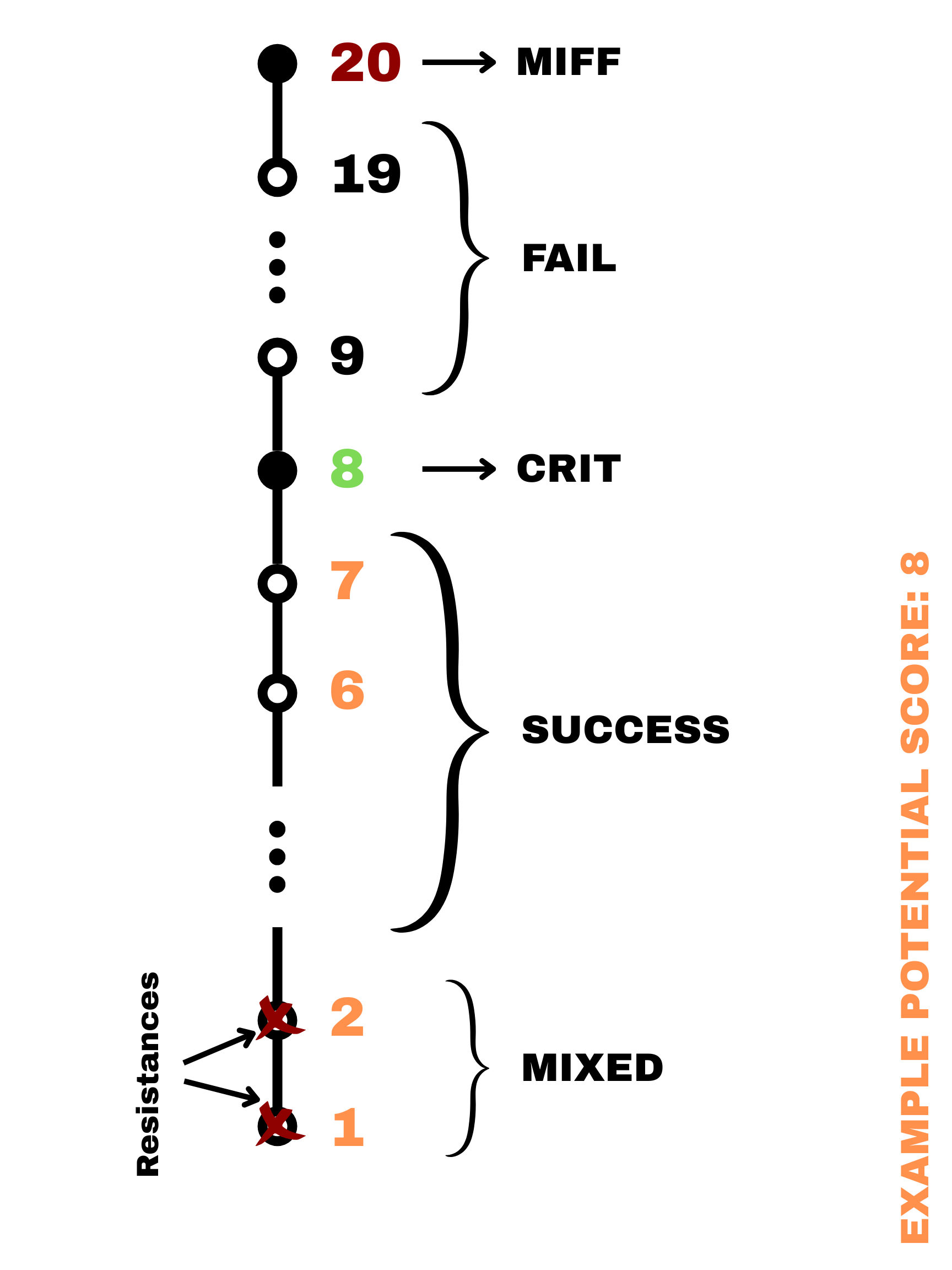
The Rule of Narrative Ease
During gameplay, there are many situations where taking action may not require a test of a character's ability, and can be resolved purely narratively. As long as the situation is low-risk, players shouldn't need to make a Test roll at all as long as they have the time to do it unhurriedly. Remember your heroes are capable! Be sure not to bog down the narrative flow with excessive Skill Tests, and allow players to tell the story they want to build.
Note: When a player's Test results in a success level of 3 or below (Mixed, Failure, Miff), they gain a Beat.
Emphasized Rolls
Crits and Miffs are major story beats that represent parts of the hero's journey. Rolling either of these success levels naturally on the D20 has additional mechanical effects defined below:
Rolling Natural Crits
Rolling a Natural Crit not only counts as an automatic best plausible outcome, but also allows a player to recover a Resistance point of their choosing.
Rolling Natural Miffs
Rolling a Natural Miff counts as an automatic worst plausible outcome, and causes an additional loss of a Resistance point in the Potential used in the triggering Test.
The 5 Simple Steps to Finding Success
- Determine how many dice are in your Volatility Pool* (between Skill Proficiency, Knacks, a Domain, Riskiness, and Ability Effects).
- Roll your D20 and your Volatility Pool.
- Determine the base success level (determined by D20 and Potential Score). If it's a Natural Crit or Natural Miff, you have your answer!
- Determine the highest Volatility Die from your Pool, resolve Perks*, and determine its success level modifier (+1, -1, etc.).
- Combine your base success level with your success level modifier to receive your overall success level!
See *Volatility for modifying Test success levels!
Additional Test Types
Hybrid Tests
If the GM believes testing a Skill in a certain Test should require a different Potential score, they may decide to call for a Hybrid Test. The GM may state this by declaring something similar to "make a Wit (Sleight) test." This is executed by rolling a Test under the declared Potential (Wit), but determining the Volatility Pool based on proficiency in the declared Skill (Sleight)1.
Risky Tests
Rolls with significant difficulty may become risky. A normal test represents the first level of Riskiness. A Test threatens Stress and even Fallout, so they should only be called for in somewhat risky situations.
Higher levels of riskiness will alter what is rolled in a player's Volatility Pool:
| Level | Riskiness | Modifier to Volatility |
|---|---|---|
| 0 | Uncertain | None, regular roll |
| 1 | Risky | -1 Volatility Die |
| 2 | Dire | -2 Volatility Dice |
| 3 | Desperate | -3 Volatility Dice |
If the modifier would ever cause the Volatility Pool to be less than zero (-X), then roll X + 1 Volatility Dice, and take the lowest result instead of the highest.
Advantage/Disadvantage
If a Test is given Advantage, then it is rolled with -1 level of Riskiness (see above). If the Riskiness Level is lower than zero, a Volatility Die is added to the pool instead. If a Test is given Disadvantage, then it is made with +1 level of Riskiness.
Subtle Tests
When the result of a Test will not be immediately confirmable, the GM can choose to make the roll a Subtle Test. This means the player will only resolve their Volatility Pool, but the GM rolls the D20 for the player, and is the sole witness to the base Success Level. This creates a level of suspense, where the player has some idea of their capability, but will only learn the exact impact of their roll once it becomes narratively relevant. This could most often be used for Recall Tests for remembering historical facts, but could also be used for Tests made to avoid the perception of an adversary, glean the intents of another character, or prepare new and untested forms of technology or Magick.
-
Other sources of Volatility such as a Domain, Knacks, and abilities are added as normal. ↩